Scoring modes for multi-part questions
Points pooled at the question, or owned by each part. Pick per question.
A multi-part question (Q2 with parts a, b, c) can be scored two ways. InteGrade infers the mode from how you assign points, so you set this simply by where you put the numbers.
Pooled scoring
Give the parent question the full point value and leave every subpart at 0. All deductions across the parts draw from one shared pool, and the question score is floored at zero.
Example: Q2 is worth 8 points; 2a, 2b, 2c are each 0. A student loses 3 points on 2a and 7 on 2b. The pool empties at 8 lost, so Q2 scores 0, not negative.
Use this when the question is one connected piece of work and you think of it as "8 points for Q2," not "2 + 3 + 3."
Per-part scoring
Give each subpart its own point value. Each part has its own pool and its own floor, and the parent's total is simply the sum, shown for reference.
Example: 2a is 2 points, 2b is 3, 2c is 3. A disastrous 2a cannot drag down credit earned on 2b and 2c.
Use this when parts are independent and you want guaranteed credit for each.
Mixing the two
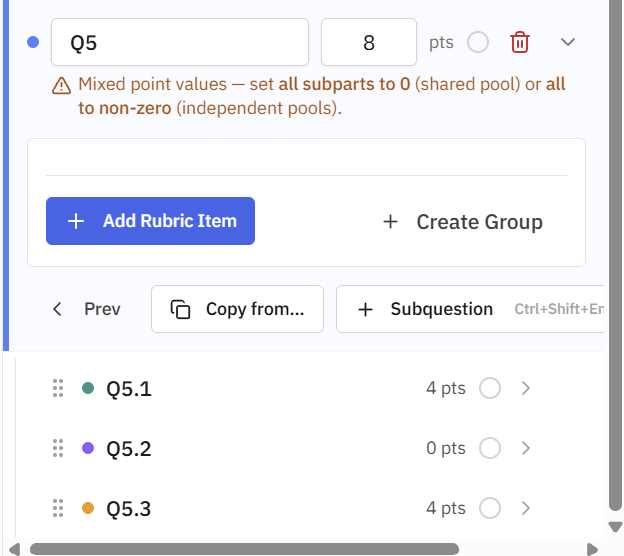
Within a single question, mixing does not work: if some subparts have points and others are 0, InteGrade flags the question with a warning in the outline editor and scores it per-part until you resolve it. Different questions on the same assignment can use different modes freely.
One special case
A parent at 0 points with all subparts at 0 is valid. It is treated as an organizational, zero-point question, handy for checks like "On time / Late."